Starting an Advisory Board: an Execution Challenge
By Jennifer Mondoux
June 3, 2026
Starting an Advisory Board: An Execution Challenge that Catches Many Private Company Leaders by Surprise
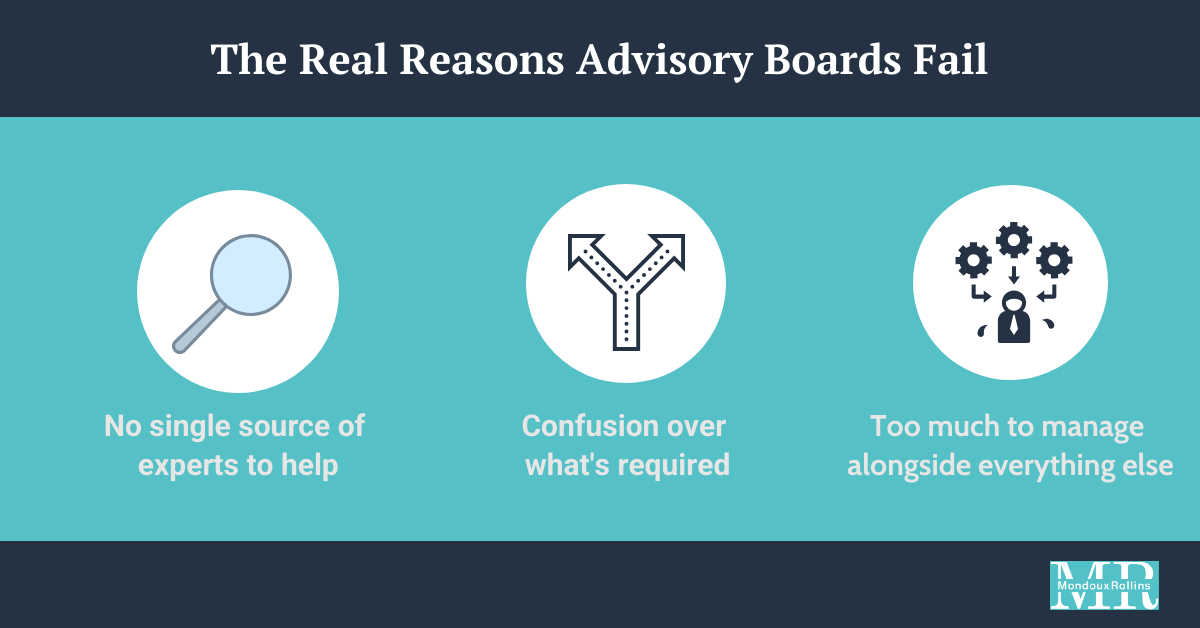
Three issues come up again and again when private company leaders talk about starting an advisory board:
There's no clear, single source of expertise on how to do it well
There's confusion about what's actually required (and often overcomplication)
And perhaps most importantly, it simply feels like too much to manage alongside everything else
The typical pattern is this: There's interest in an advisory board. The conversation starts. And then it stalls.
Not because the idea isn't valuable (because it very much is), but because the path forward isn't clear or feels heavier than expected.
The reality: it's not just about deciding to have a board
One of the biggest misconceptions is that launching an advisory board is primarily a strategic decision.
It is that indeed, but it's also an execution challenge. One that's underestimated.
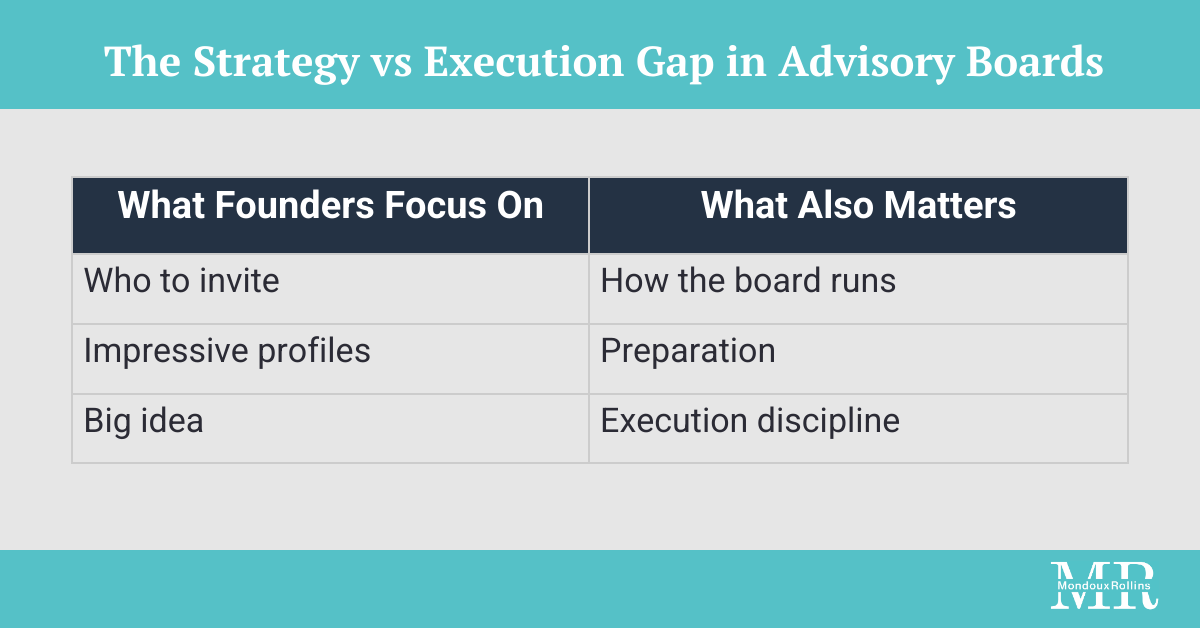
Leaders of private companies spend time thinking about who they'd like around the table, but not enough time thinking about logistics:
How the board will run
How prepared they need to be
What kind of experience they're creating for their advisory board members
From what we've learned across 300+ nominations to our Canada's Best Private Boards program, and in our executive search practice working directly with private companies, most advisory boards stumble (and might even fall) before getting out of the gate because of execution problems.
Who are advisory boards really for?
We see the strongest impact with:
Founders and entrepreneurs looking to bring experienced perspective into their growth journey
Family business leaders considering governance for the first time
CEOs of private companies looking to reach a new level of performance
A well-run advisory board can provide:
A sounding board
Strategic guidance
Constructive challenge
Ongoing support
And importantly, a new lens on growth and strategy
And across the strongest examples: They also start small.
--
If you are thinking about starting an advisory board, here are a few must-haves so that you come across as focused and organized, and thereby able to attract the people you want:
1: Determine your "Why"
That means being explicit about why you want an advisory board:
What decisions you want to improve
Where you want challenge and perspective
How this connects to your strategy and growth
2: Practice articulating your narrative.
Most leaders start with: Who should I approach about joining my advisory board?
But the better question is: Why would a great advisor say yes?
Board advisors are evaluating the opportunity:
How well it's thought through
Whether their time will be used effectively
Whether this is something real
When you are approaching potential board advisors, you should be clear on the gaps in your own experience as a founder or CEO, the expertise required to support your strategy and alignment with how you work.
You should also be able to effectively tell the story of both your organization, and the opportunity.
Private company advisors and independent directors are looking to provide value but also to be a part of a journey. Be effective in articulating your story - warts and all.
3. Figure things out in advance.
Without some degree of preparation as you launch an advisory board, expectations become unclear, professionalism suffers and credibility is undermined. You will also not have the same beneficial experience.
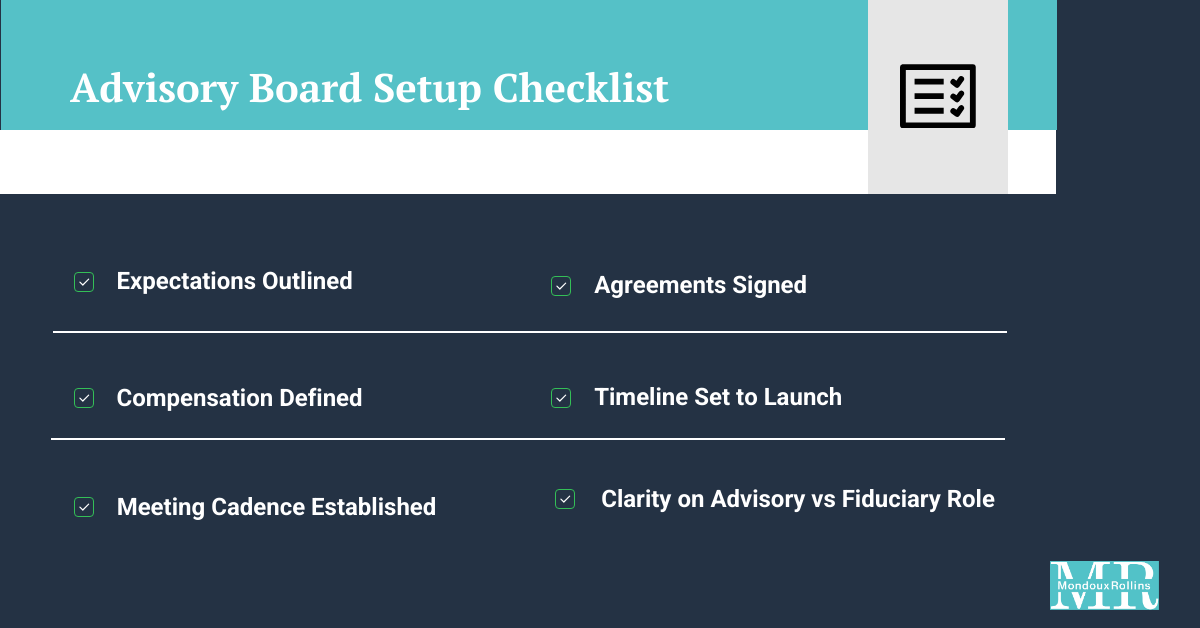
Can you confidently check off the following items?
You have outlined expectations
You have agreements in place (in writing, see below)
You have a clear timeline to launch
You have defined the meeting cadence
You have sought expert guidance on what you should talk about in these meetings
You have sought clarity on what the role of an advisory board is (and you also understand that these individuals are not fiduciaries).
And critically, something that often gets ignored: you have had open discussions about how you will compensate your advisory board members, and what that compensation will mean in terms of expectations and commitment.
Put all of this in writing. It doesn't have to be complicated. In fact, in most cases with an advisory board, a simple, standard advisory services template will do.
4. Run it like it's real
You need to run your advisory board like it matters.
Because it does.
This means:
Scheduling meetings in advance
Confirming attendance
Sending clear, focused agendas
Preparing proper board materials
Tracking discussions and follow-ups
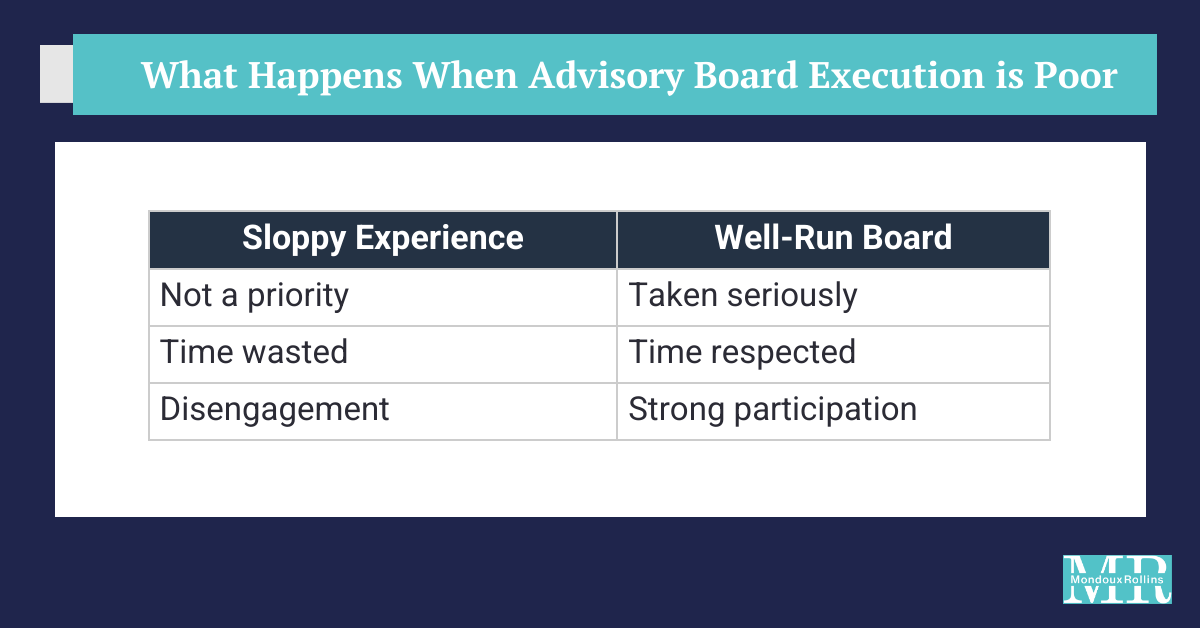
Because when the experience is sloppy, it reflects poorly - on you.
It signals the following to your advisory board members:
This isn't a priority
Their time isn't being respected
The board isn't being taken seriously
When that happens, you won't be able to retain the right people.
It will be deflating for everyone.
Here’s the difference between advisory boards that are run well—and those that aren’t:
5. Get support
CEOs and other leaders of private companies are very busy people. There is operational lift required to run an effective advisory board, and there simply aren't enough hours in the day to do it.
Take it off your plate.
Find a trusted, in-house support person who excels at administration. Or, find a partner with expertise in private company governance who can provide these managed services on your behalf.
There is real effort involved in:
Coordination
Scheduling
Preparation
Follow-through
And it all needs to happen consistently.
Truthfully, not being organized can mean the difference between an advisory board that simply exists (and likely has a limited shelf life) to an advisory board that works - providing the strategic guidance, constructive challenge and ongoing support you are looking for.
Final thought: execution is what unlocks value
Advisory boards aren't difficult because the idea is flawed.
They're difficult because:
There's confusion about what's required
It feels operationally heavy
And execution is underestimated from the start
But the leaders of private companies who get this right understand something simple: this is not about having a board. It's about running one properly.
Start small.
Be clear on your purpose.
Set expectations upfront.
And create a professional, consistent experience.
That's what allows you to attract the right talent - and actually benefit from it.
To find out more about how we can help you launch your first advisory board, please visit our services page on our Canada’s Best Private Boards website. Click HERE.
About the Author:
Jennifer is a human capital advisor and talent solutions professional, with nearly two decades' worth of experience working with private companies. An exceptional search professional, she has helped dozens of founders and entrepreneurs of mid-market companies build out their senior leadership teams. Jennifer is seen as a trusted advisor, with an expertise that allows her to guide clients through the lifecycle of their talent needs.
She is also the founder and chair of Canada's Best Private Boards, a first-of-its-kind national and annual program that recognizes the impact of governance on the performance of private companies.
About MondouxRollins Partners Inc.:
MondouxRollins Partners Inc., is an executive search and human capital advisory firm. We are a group of specialists, equipped with decades of experience providing talent solutions for private companies. We are risk-mitigators, trusted advisors and relationship-builders, and we are your one-stop-shop through the entire talent lifecycle - for your team, or for your board. We are also the founders of the Canada's Best Private Boards program, a first-of-its kind national and annual awards program that recognizes the impact of governance on the performance of private companies.
About Canada's Best Private Boards:
Since 2023, our awards program has been recognizing the impact of great governance on the performance of private companies. We are cultivating a national culture of best practice sharing around private company governance, where leaders learn from real, validated examples of board excellence.
Now entering its third year, the program continues to build strong momentum with an expanding community and deep engagement from business leaders nationwide. Since inception, we have received 300 nominations and participation now includes some of Canada's most recognizable privately-held brands.